
Which Audio Format Should You Record In?
 By HenrikUpdated Aug 7, 20267 min read
Choose MP3, WAV, FLAC, or M4A for recorded audio based on listening, editing, archiving, metadata, storage, and playback needs.
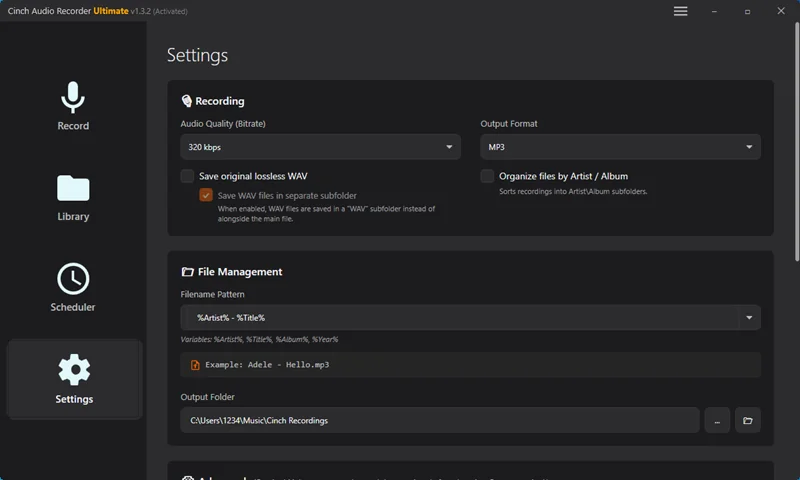
The best audio format is not the biggest one. It is the one that fits what you will do with the recording next.
If the file is for casual listening, a compact format is usually better. If the file will be edited, trimmed, restored, or archived, a lossless working copy can make sense. If the file needs to show up correctly in players, metadata support matters too.
The Short Answer
Use this quick decision path:
| Need | Format to Consider | Why |
|---|---|---|
| Everyday listening | MP3 or M4A/AAC | Small, common, easy to move |
| Editing copy | WAV or FLAC | Avoids another lossy step during cleanup |
| Long radio or lecture archive | MP3/M4A for size; FLAC only if needed | Storage matters over long sessions |
| Music library with tags | MP3, M4A, or FLAC | Better player metadata support than raw WAV workflows |
| Support sample | MP3 or WAV | MP3 is compact; WAV is easy to inspect |
| Ringtone or short clip | MP3 or phone-supported format | Compatibility matters more than file size theory |
Do not export everything as WAV just because it sounds professional. WAV can be useful, but it also creates large files and does not magically improve a compressed source.
MP3: The Practical Listening Copy
MP3 is still useful because it is widely playable and small enough for ordinary listening folders, USB drives, phones, and support samples.
Choose MP3 when:
- The recording is for everyday playback.
- You need a smaller file.
- You want easy compatibility.
- You do not plan heavy editing later.
- You are creating short clips, reference files, or casual archives.
The downside is that MP3 is lossy. If you repeatedly edit, export, re-import, and export again, quality can degrade. For a final listening copy, that is often acceptable. For a working copy, use something else first.
M4A/AAC: A Compact Modern Listening Format
M4A usually means AAC audio in an MP4-style container. It can be a good choice for compact listening files and many modern players.
Choose M4A/AAC when:
- Your devices already handle it well.
- You want compact files.
- You prefer a modern lossy format.
- The recorder or browser supports the export reliably.
Check compatibility before building a whole library around it. Some older players, car stereos, or simple devices may still behave better with MP3.
WAV: The Simple Editing Copy
WAV is uncompressed PCM in many common workflows. It is easy for audio editors to open, but it can be much larger than MP3 or M4A.
Choose WAV when:
- You plan to trim, normalize, reduce noise, or process the file.
- You need a simple working copy before making a smaller final file.
- You are sending a short diagnostic sample where size is not a problem.
- You want to avoid another lossy export during cleanup.
Avoid WAV when:
- The recording is long and storage is limited.
- You only need a listening copy.
- You assume it will improve a low-quality source.
WAV is honest, not magic. It can preserve what reached the recorder, but it cannot add detail that was not there.
FLAC: Lossless With Better Storage Efficiency
FLAC is lossless like a WAV working copy, but it usually uses less storage than WAV. It can also be better for music libraries because metadata and artwork are commonly used with it.
Choose FLAC when:
- You want a lossless archive.
- You care about keeping metadata with a music file.
- You have enough storage.
- You expect to revisit or reprocess the recording later.
Do not use FLAC simply because it looks premium. If the source was already compressed and you only need phone playback, MP3 or M4A may be more practical.
Why Lossless Does Not Mean Better Than the Source
This is the most common format mistake.
If the source stream was compressed, saving the result as WAV or FLAC does not recreate the original studio file. It only avoids adding another lossy compression step at export.
That can still be useful. For example, if you plan to trim, normalize, and then create a final MP3, keeping a WAV or FLAC working copy during editing can reduce avoidable degradation. But a lossless container is not a quality upgrade button.
Format Choices by Recording Type
| Recording Type | Starting Format | Final Format |
|---|---|---|
| Short browser sample | MP3 or WAV | MP3 for sharing |
| Streaming music for personal listening | MP3 or M4A | MP3/M4A with checked metadata |
| Music you expect to edit | WAV or FLAC | MP3/M4A for listening, lossless copy if needed |
| Online radio show | MP3/M4A unless editing | MP3/M4A with clear date-based name |
| Lecture or webinar | MP3/M4A | MP3/M4A after trimming silence |
| Voice note | MP3 | MP3 after cleanup |
| Support diagnostic file | WAV for short files, MP3 for longer files | Whatever support asks for |
If you are not sure, start with a short test recording and run it through the Recording Quality Checker. It is easier to choose a format after you know whether the file is silent, clipped, too quiet, or already usable.
For long sessions, choose the format before you start and check storage first. The best settings for long audio recording guide covers the full preflight routine for radio, webinars, classes, playlists, and live streams.
If you already know the format but not the quality setting, use the bitrate guide for recorded audio to choose a practical starting point for voice, music, long sessions, and sharing.
If the finished file needs to play from a dashboard USB port, use the car USB audio conversion guide after choosing a format. Car playback often depends on conservative MP3 copies, simple filenames, and tags the dashboard can read.
If you already recorded the file and the extension is not what you expected, use the wrong audio format after recording guide before deleting or re-recording. Often the safer fix is to convert a copy and keep the original until playback is checked.
Metadata and Format
Format is not only about sound. It also affects how cleanly a file can carry title, artist, album, artwork, comments, and lyrics.
For music libraries, MP3, M4A, and FLAC are usually easier to manage than plain WAV. That does not mean WAV is bad; it means it is often better as a working file than a polished library file.
After recording, use this sequence:
- Play the file.
- Check whether the content is correct.
- Trim or normalize if needed.
- Choose the final format.
- Add title, artist, artwork, comments, or filename cleanup.
The record audio with metadata guide goes deeper into that finishing pass.
A Simple Rule for Cinch Users
For repeated streaming-audio recording, choose a format you will actually keep organized.
- Use MP3 or M4A for ordinary listening libraries.
- Use WAV or FLAC only when you have a reason to edit or archive.
- Use filename patterns and metadata review so the format choice does not become a folder of mystery files.
- Test one familiar source before recording a long playlist.
If you need the desktop workflow, start from the Download Center. If you only need to convert a finished local file, use the Online Audio Format Converter.